Discontinued PLC and automation parts
Lifecycle status for 58 PLCs, drives, HMIs and I/O modules from 9 manufacturers that are being retired or have already gone, with what each stage means for a running plant and what to do next.

How ECS lifecycle stages work
Every manufacturer names its stages differently. ECS maps them onto one scale, based on Siemens' sequence, because most engineers already know it. Each part page shows the ECS stage and the manufacturer's own term side by side.
-
Active
The manufacturer sells and supports the part normally. No action needed beyond knowing where it is and keeping a current backup.
-
Phase Out
The manufacturer has announced it is retiring the part. It can usually still be ordered, often as a last-time-buy window. Start planning: count your units, back them up, decide on spares, price the successor.
-
Cancellation
Normal sale has ended. Remaining stock or designated spares may still be available, and support usually continues for a period. Spares and a migration plan should be active now.
-
Total Discontinuation
The manufacturer no longer supplies or repairs the part. Surplus and refurbished stock may exist, but that is not a supply chain. The backup and the migration plan are what protect you.
By manufacturer
Parts in Phase Out
- CMMO-ST-C5-1-LKPFesto CMMO-ST
- GT2712-STBDMitsubishi GOT2000 GT27
- QD62EMitsubishi MELSEC-Q
- 1756-M08SERockwell ControlLogix
- 1762-IQ16Rockwell MicroLogix 1200
- 1762-OB8Rockwell MicroLogix 1200
- 1762-OW16Rockwell MicroLogix 1200
- 6ES7431-1KF00-0AB0Siemens SIMATIC S7-400
- 6ES7460-1BA01-0AB0Siemens SIMATIC S7-400
- 6ES7461-1BA01-0AA0Siemens SIMATIC S7-400
Parts in Cancellation
- BSD0400ABB BSD Series
- BSD1500ABB BSD Series
- UNO-2362GAdvantech UNO-2000
- FR-E520S-2.2K-ECMitsubishi FREQROL-E500
- FR-E540-5.5K-ECMitsubishi FREQROL-E500
- FR-E740-060-NAMitsubishi FREQROL-E700
- FR-E740-120SC-ECMitsubishi FREQROL-E700
- FR-E740-300SC-ECMitsubishi FREQROL-E700
- FX2N-48MT-ESS/ULMitsubishi MELSEC-F FX2N
- NB5Q-TW01BOmron NB Series
- GP-4402WWProface GP4000E
- 1746-NR4Rockwell SLC 500
- 1746-NR8Rockwell SLC 500
- 1746-OB32ERockwell SLC 500
- 1762-L40BXBRockwell MicroLogix 1200
- 1783-EMS08TRockwell Stratix 6000
- 2080-LC30-48QWBRockwell Micro800
- 2094-BC07-M05Rockwell Kinetix 6000
- 2094-BM01-SRockwell Kinetix 6000
- 2094-BMP5-SRockwell Kinetix 6000
- 22D-D1P4N104Rockwell PowerFlex 40P
- 22D-D4P0N104Rockwell PowerFlex 40P
- 2711-M3A18L1Rockwell PanelView
- 2711P-RPRockwell PanelView
- 2711PC-T6C20DRockwell PanelView
- 6ES7132-6BD20-0BA0Siemens SIMATIC ET 200SP
- 6ES7153-1AA03-0XB0Siemens SIMATIC ET 200M
- 6ES7353-1AH01-0AE0Siemens SIMATIC S7-300
- 6ES7361-3CA01-0AA0Siemens SIMATIC S7-300
- 6ES7365-0BA01-0AA0Siemens SIMATIC S7-300
- 6ES7510-1DJ01-0AB0Siemens SIMATIC ET 200SP
- 6ES7513-1AL02-0AB0Siemens SIMATIC S7-1500
- 6SN1146-1AB00-0BA1Siemens SIMODRIVE 611
Parts in Total Discontinuation
- A1SX80Mitsubishi MELSEC-AnS
- A2ASCPUMitsubishi MELSEC-AnS
- FR-E520S-1.5K-ECMitsubishi FREQROL-E500
- FR-S520SE-0.75K-ECMitsubishi FREQROL-S500
- FX2N-4ADMitsubishi MELSEC-F FX2N
- Q01CPUMitsubishi MELSEC-Q
- Q06UDEHCPUMitsubishi MELSEC-Q
- 650/040/400/F/00/DISPR/UK/RSO/0Parker AC650
- 650V-43155020-BF1P00-A2Parker AC650V
- 650V/075/400/F/00/DISPR/UK/RS0/0Parker AC650
- 1747-SNRockwell SLC 500
- 6AV7882-0CA10-4BA0Siemens SIMATIC IPC
- 6GK7343-1EX21-0XE0Siemens SIMATIC S7-300
- 6GK7343-2AH00-0XA0Siemens SIMATIC ET 200M
- 6SN1123-1AB00-0AA1Siemens SIMODRIVE 611
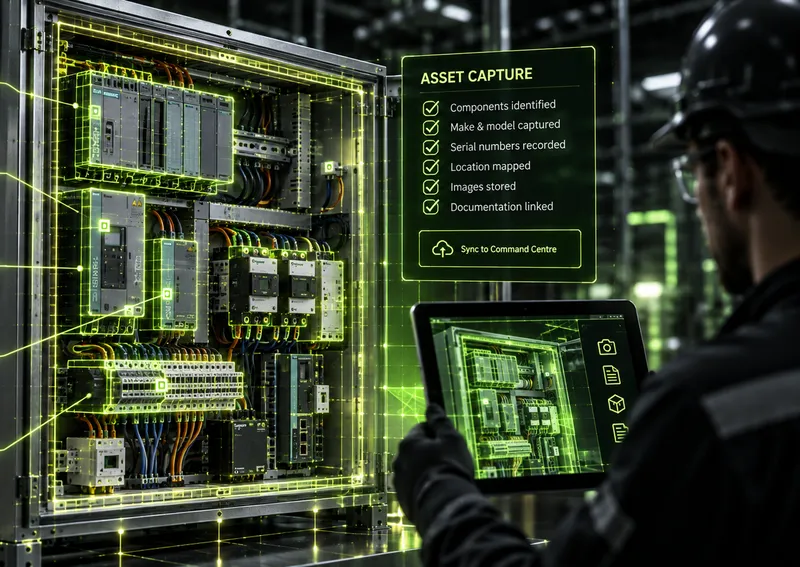
Which of these are running on your site?
A Capture audit finds every PLC, drive and HMI on your site, takes a backup of each one it can reach, and records the software version and cable needed to restore it. When a discontinued unit fails and a replacement turns up, the program is ready to load.
- Every device located, photographed and lifecycle-checked
- Backups taken on the day, with software version and cable recorded
- Findings report, plus a populated Command Centre
- No production downtime
Common questions
What is the difference between phase-out and discontinued?
Phase-out means the manufacturer has announced it is retiring a part, but it can usually still be ordered. Cancellation means normal sale has ended, though spares and support may continue for a period. Total discontinuation means the manufacturer no longer supplies or repairs the part at all. Manufacturers use different words for each stage, so ECS maps them onto one scale and shows the manufacturer's own term alongside.
Does a discontinued PLC need replacing straight away?
No. A discontinued PLC keeps running exactly as it did the day before. The risk arrives when it fails. The priorities are to know where every unit is, hold a current backup of each program, decide which spares to keep, and plan the migration before a failure forces it.
Where does ECS's lifecycle status come from?
Where a manufacturer publishes lifecycle information, the part page names and links that source. Where it does not, or where ECS's information differs, the page says it is an ECS lifecycle assessment, based on the lifecycle data ECS holds in Command Centre, and shows the manufacturer's published term alongside. Every page shows when it was last checked. Always confirm a specific part's status with the manufacturer before buying or planning a migration.
How do I find out which discontinued parts are on my site?
A Capture audit. ECS engineers walk the site, catalogue every PLC, drive, HMI and I/O module, check each part number against lifecycle status, and back up every program they can reach. You get a findings report and a populated Command Centre.